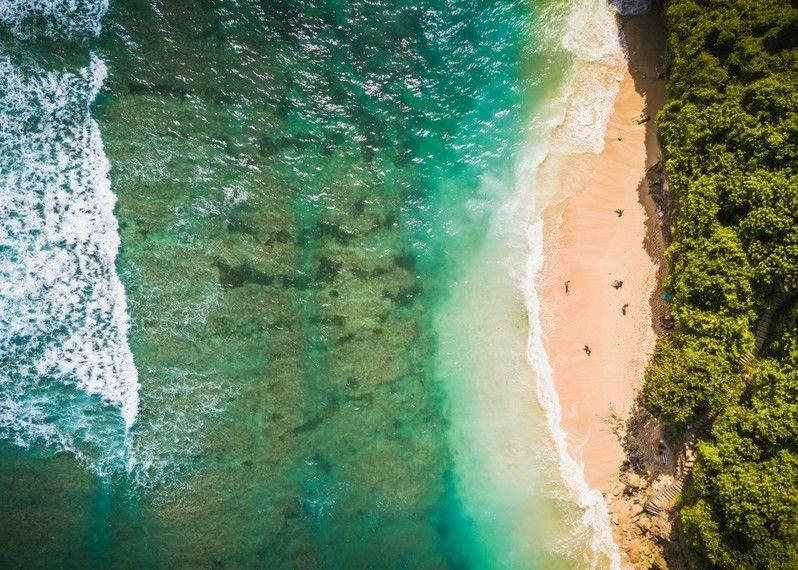
Pack your bags and weapons, we are taking you to one of the world's most exciting land paradises: the island of Cape Verde! An African state consisting of an archipelago of no less than 10 islands of volcanic origin plus 8 small islets. In short, a jewel set in the ocean. Let's find out more!
Informed travel: useful info
Inhabitants: about 550,000
Capital: Praia
Languages: Portuguese (official) and Cape Verdean Creole
Local currency: Escudo Capoverdiano (1 euro = 110 escudos)
Climate: tropical, with average temperatures of 24-25° C
Time zone: GMT-1 (-2h compared to Italy, -3h when daylight saving time is in force in Italy)
Vaccinations: no vaccination required
Entry requirements: valid passport and tourist visa (approx. €25.00) to be obtained from an agency, airport or embassy
Distance from Italy: 4,500 km (8-9 hours flight time)
Security info: visit the Cape Verde section on the Farnesina website
Where is Cape Verde located?
Cape Verde is located 500 km off the west coast of Africa, just south of the Canary Islands, in the middle of the Atlantic Ocean. The metropolitan city of Dakar, on the Senegalese coast, is an excellent overseas reference point. In the capital Praia we find the international airport that connects the archipelago with the rest of the world.
How to get there
The main stopover for departures to Cape Verde is Lisbon with TAP Air Portugal. Therefore, from any Italian airport, it is possible to reach the island by first finding a connecting flight to the Portuguese capital. Below are the combinations from the two main national airports.
FromMilan: flight from Milan Malpensa with a stopover in Lisbon. Total duration: 8 hours - Compare flights from Milan - from €321.55
FromRome: flight from Rome Fiumicino with a stopover in Lisbon. Total Duration: 9 hours - Compare flights from Rome - from €426.75
When to go? Info on climate and best time
Month | Average temperatures (min/max) | Precipitation (days/mm) |
|---|---|---|
January | 19 / 25° | 1 day / 2 mm |
February | 19 / 25° | 0 days / 0 mm |
March | 19 / 26° | 0 days / 0 mm |
April | 20 / 26° | 0 dd / 0 mm |
May | 20 / 26° | 0 dd / 0 mm |
June | 22 / 26° | 0 dd / 0 mm |
July | 23 / 27° | 1 day / 3 mm |
August | 24 / 27° | 5 days / 50 mm |
September | 24 / 27° | 5 days / 80 mm |
October | 24 / 27° | 3 days / 25 mm |
November | 23 / 27° | 1 day / 6 mm |
December | 21 / 25° | 1 day / 2 mm |
Climate: tropical. Mild all year round, average temperature 25 degrees
Best period: between May and July and from November to December, when the air is less humid and the temperature range between day and night is reduced
Periodto avoid: there is no period to avoid. Let's say that August, September and October are the most humid and sultry months, with some more rainfall, but in reality it does not rain often during this period either. Between January and March, on the other hand, cool winds blow
Recommendations: the climate in Cape Verde is good practically all year round. However, cool breezes blow between January and March, which can make you wear a jumper, but more importantly, they can make the sea rough and thus impair bathing activities - find out more about the climate in Cape Verde
Which island to choose?
 Cape Verde consists of 18 islands in total, but only 9 of these are inhabited. They are divided into two groups:
theBarlavento (or Windward) in the north, characterised by a drier climate, and are: Santo Antão, São Vicente, Santa Luzia, São Nicolau, Ilha do Sal, Boa Vista;
the Sotavento (or Leeward) in the south, slightly wetter, and are: Maio, Santiago, Fogo, Brava.
But the main tourist islands are three:
Sal: served by Amilcar Cabral airport, the arrival point for almost all international European flights. This certainly makes it the easiest island to reach by plane from Italy. It is very built up and richer in services than the others - find out more about the Island of Sal
Boa Vista: served by the Aristides-Pereira airport. It is much wilder and more enjoyable than the others, especially for those who want a relaxing holiday on the beach - learn more about the island of Boa Vista
Santiago: served by the Nelson Mandela airport, landing point for flights from America. On this island is the most important city with many nightlife venues, the capital Praia
How to get from one island to another
Travelling between islands is by air taxi and takes about 20 minutes (prices from €150.00 return). It is difficult to move easily on the same day, especially because during the high season the planes are very crowded. For this reason, it is recommended to devote your holiday to discovering just one of the islands or at most a couple of them (having at least 10 to 15 days available).
Internal travel between one side and the other of the same island is provided by continuous and inexpensive ferries (from 440 escudos, about €4.00).
What to see and do
 Cape Verde, with its sister islands, offers local and colonial history, golden beaches and crystal-clear waters, natural and architectural monuments, as well as markets and entertainment. Here, where European and indigenous culture mingle, here are the most important places to visit:
SEE ALSO: Cape Verde's most beautiful beaches
1 - The capital Praia, Santiago Island
 Piazza XII Settembre is the symbol and beating heart of Santiago Island and hosts music and entertainment. Equally iconic is the Maria Pia Lighthouse in Ponta Termosa, an evocative place that recalls the close relationship between the locals and the sea.
The Ethnographic Museum is a symbol of the Portuguese colonisation of the archipelago. Together with the Palace of Justice and the Municipal Palace, it guards the historical memory of the inhabitants, which we recommend you discover on a guided walking tour.
But that's not all, several unmissable excursions depart from Praia. The tour of Santiago Island, which offers a unique experience, allows you to visit the Assomada market, drive a vehicle through the Serra Malagueta, swim in the bay of Tarrafal and meet an ancient Cape Verdean tribe.
Equally impressive is the tour of the banana plantation and the Cuscuz rum distillery, which allows you to admire some of the most beautiful landscapes on the island.
Finally, Praia is also very well connected to the other islands of the archipelago thanks to the Fast Ferry company's ferries and internal flights (the latter to be preferred as they are faster).
2 - Royal Fortress of San Felipe, Cidade Velha, Santiago Island
Since 2009, together with the city that hosts it, it has been a Unesco World Heritage Site. This imposing structure bears witness to military assaults, corsair uprisings and pirate tales. So important was its strategic location that it aroused the (military) interest of the Portuguese, British and French.
3 - Pico do Fogo Volcano, Fogo Island
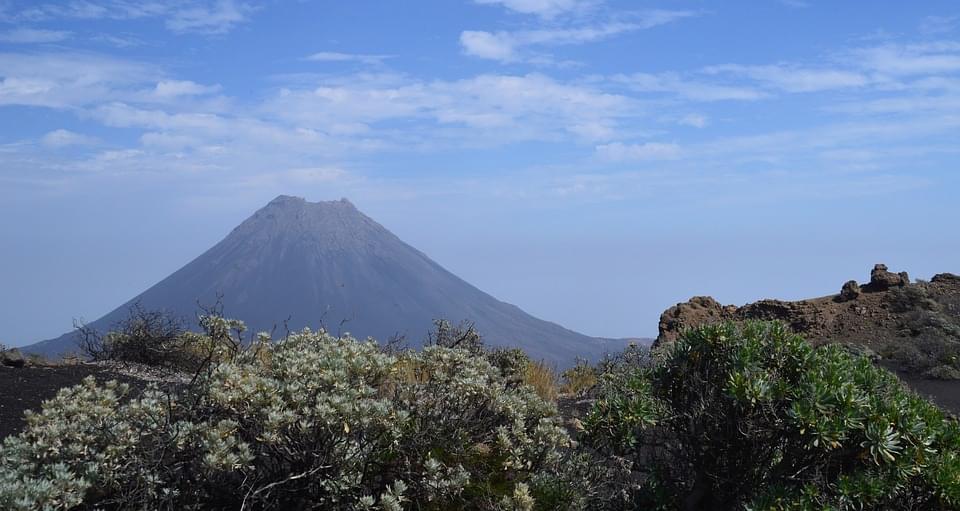 At a height of 2,829 metres, we find ourselves on the highest peak of the entire archipelago. A wonder for enthusiasts who can visit an active stratovolcano, with eruptive fissures along its flanks. It is possible to take aguided excursion to admire literally breathtaking landscapes. The last eruption was in 2014.
4 - Sal Island
In the middle of the Atlantic Ocean, this beautiful island offers several wonders. Starting with the wonderfully wild beaches. The most famous is certainly Praia de Santa Maria, a long white sandy beach offering a dreamlike landscape.
Other places and attractions of interest are Ponta Preta, a promontory in the south-west of the island belonging to the Ponta do Sinó nature reserve, Monte Leão, an area where one can go trekking but also surfing on the windswept beaches, and the majestic Olho Azul, (also known as Blue Eye), a beautiful natural pool near Buracona.
As for activities, in Sal it is possible to dive in volcanic springs, spot lemon sharks in Baia de Parda, snorkel in Murdeira Bay and look closely at turtle nests on Santa Maria beach. The best way to enjoy all this is to join an organised tour with a local guide. And after all these experiences, be sure to also admire the island from the perspective of the sea by enjoying a fantastic catamaran tour.
SEE ALSO: Sal Island - where it is, what to see, when to go
5 - Sâo Vincente Island
 Photo by Manuel de Sousa. This island is recommended for lovers of nightlife and entertainment. In the port city of Mindelo you will find discos, pubs and even the best beaches! If you go in February, take the opportunity to experience the local version of Brazilian carnival!
6 - Boa Vista Island
 This small island isideal for kitesurfers and windsurfers, who can enjoy the ocean currents and winds. In addition to offering pristine beaches, Boa Vista is known for its desert hinterland, all to be explored through fantastic quad bike adventures departing from the town of Rabil.
From the city of Sal Rei, on the other hand, you can set off on excursions and photo safaris. For example, you can join a whale watching tour, one of the most exciting activities ever.
Finally, you can also admire the wreck of the ship Cabo Santa Maria, which was shipwrecked in 1968 on Atalanta beach on Boa Vista Island.
SEE ALSO: Boa Vista Island - where it is, when to go and what to see
7 - Sâo Nicolao Island
 Source: wikimedia commons. Cape Verde also satisfies lovers of altitude. For an off-the-beaten-path day, you can head to the mountain ridges of this island, up to Monte Gordo, at an altitude of 1,312 metres. Can you already imagine the breathtaking view of the archipelago?
How much does a holiday in Cape Verde cost
Let's cut to the chase, though. How much does it cost to book a holiday among these wonderful islands? If you like to decide for yourself what to do and when to do it, the ideal solution is to stay at an accommodation close to the beach and the city centre.
If, on the other hand, you like to be pampered and want to enjoy every moment of comfort, you can turn to establishments that offer all-inclusive packages for a week.
On average, a one-week package for 2 persons in 4-star all-inclusive resorts is around €1,900.00, including flights from Rome or Milan.
For a do-it-yourself holiday, check out our offers:
Where to stay: 1 week in a 4-star hotel from €590.00 per couple - see offers
Low cost flights: Cheap return flights from Rome or Milan from €321.55 - look at the offers
Flight + hotel: A/R flight + 7 days from €998,00 per person - look at the offers
Miscellaneous costs and cost of living
Espresso coffee: from 50 escudos (€0.45) in less touristy areas to 100 escudos (€0.90) in touristy areas;
Bottled beer (33cl): from 90 escudos (€0.80) in less touristy areas to 150 escudos (€1.40) in tourist areas;
Seafood dinner by the sea for 2: from 250 escudos (€2.28) in less touristy areas to 2,500 escudos (€22.80) in tourist areas
Packet of cigarettes: from 190 escudos (€1.70) in less touristy areas to 250 escudos (€2.28) in tourist areas;
Tourist rental: 1 week in high season (May-August) from €400-500
Tips: buy in local currency, you'll save about 10% because no one applies the current exchange rate.
Pictures and videos of Cape Verde
Pico do Fogo volcano, Cape Verde
Cabo Santa Maria shipwreck, Boa Vista Island