To visit Ethiopia is to have a well-rounded travel experience, one that makes one feel immediately at home. Rather than talking about what to see, one should tell how to experience this journey, particularly when travelling alone. And that is exactly what our author Piero Pasini does.
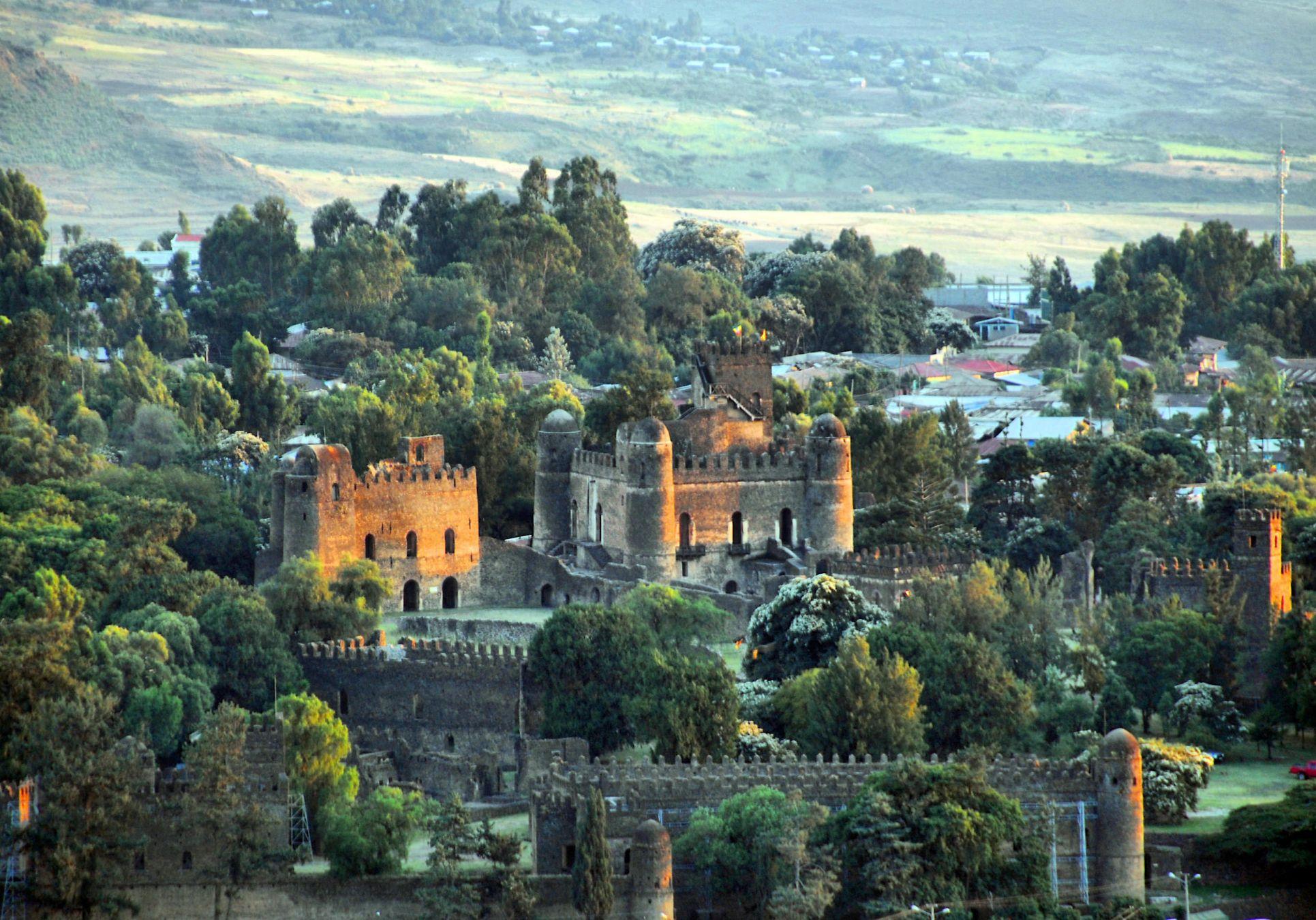
Fasil Ghebbi in Gondar, Ethiopia ©mtcurado/Getty Images
The impact is powerful. What hits me as soon as I get off the plane is a wall of air and light, containing within itself all the promise of Africa. The suggestions and expectations created by years of reading and daydreaming in front of an atlas suddenly emerge. Then something unexpected happens: I start thinking, automatically, about that strange concept that are roots. Surely I am in the right place, as the guy helping me in the indecipherable chaos of the airport car park suggests: 'Welcome home,' he tells me. Yes, because Ethiopia, in a way, is everyone's home.

Addis Ababa at sunset ©Jakob Polacsek/Getty Images
Addis Ababa
This feeling of being at home is one of the traits that lingers most on the skin of a trip to Ethiopia, and it is the people, the situations that make it possible, starting in Addis Ababa. The inextricable confusion of the megalopolis offers smiles and moments of promiscuous humanity:
- In the market, the largest in Africa, where one can find literally anything, while witnessing biblical scenes in the presence of piles of goods tens of metres high;
- In the restaurants of this gourmet city, where they serve some of the best cuisine in the country and definitely some of the best coffee in the world;
- At the National Museum, where Lucy, until a few decades ago the oldest hominid skeleton ever found, resignedly accepts to be stared at by all who pass by, as if she has realised how important her role is for humanity: to point out that we are all her children.
The author's advice
At the Addis Ababa Market it can happen that someone 'accidentally' spits at you. Do not panic, but do not lower your level of attention. While he makes excuses, trying to make up for it, he will try to clean you out... of your wallet.

Axum , Ethiopia © Piero Pasini / Lonely Planet Italy
Axum: the Ark of the Covenant
The Tablets of the Law are the relic of relics and the Bible says they are kept in the Ark of the Covenant. The mythical Ark is said to have been in Axum since the 10th century BC, brought by Menelik I, head of the Solomonic dynasty that ruled over Ethiopia for centuries. It is supposed to be kept in a chapel with a teal dome, guarded by an old priest wearing a yellow hat (in Orthodox tradition the colour of temptation). But the evocative power of Axum, a lively and crowded centre in the far north of the country, with small restaurants displaying meat in the open air and the ever-present lady making coffee, is found in the so-called palace of the Queen of Sheba, the mythical mother of Menelik, and in the Park of the Stelae.
These ruins of uncertain age (between the 1st and 4th centuries), so vividly reminiscent of Egyptian obelisks, seem to have been made on purpose to mark the transition from the ancient age to the Christian age, as they are located in one of the most sacred places of all Coptic Christianity. As soon as night falls, the city's main street, which connects the area of the Ark Chapel with the Steli Park, becomes a swarm of pilgrims dressed in white, intent on buying what are considered the best shawls in Ethiopia.
The author's advice
Groups of children, sometimes just curious, will greet you as you arrive at places or depart from them. If you want to be generous, do it, but never from the car or the vehicle you are in. A gift from the windows will make them run after you once you leave, with the serious risk of someone ending up under the wheels.

Lalibela © Piero Pasini / Lonely Planet Italy
Sign up for our newsletter! For you every week travel tips, special offers, stories from the world and 30% discount on your first order.
Lalibela
Lalibela is there but you can't see it, you think, as you jolt along in a rickety tuk tuk tuk as the sunset sky becomes a psychedelic palette. Perhaps this is also what adds to its charm. The eleven churches that characterise the so-called Jerusalem of Ethiopia are, in fact, dug underground, chiselled almost, from unique blocks of stone. To visit them one must somehow descend into an initiatory path, shoulder to shoulder with pilgrims, who walk in dark tunnels claiming to feel the presence of God there.
That the splendid churches of Lalibela were built with the help of angels, as the pilgrims who visit them deeply believe, is a suggestion into which it is easy to fall, especially when one arrives in sight of St George's. It almost looks like an alien, impossible object, a Kubrick monolith, only much more spectacular. But the churches of Lalibela are all beautiful and they are all different, sculpted, painted, 'divine' if you like, but full of humanity.
Ethiopia and Djibouti
The author's advice
Especially in the hustle and bustle of the Christmas or Epiphany pilgrimage, know that a tuk tuk (which costs very little) does not just act as a taxi. But it can wait for you everywhere or drop you off and pick you up again later.

Ghebbi Castle, Gondar © Piero Pasini / Lonely Planet Italy
Gondar
The reason why Gondar should not be called the Camelot of Ethiopia, as is common usage, is that Gondar exists and Camelot does not (although Camelot is one of the places that do not exist but should). Moreover, in Gondar, reality effortlessly surpasses fantasy. It is located 360 kilometres west of Lalibela, after a very good road built by the Chinese in the 1980s, from which one can admire endless corrugated landscapes. When one enters Ghebbi Castle, built in the 17th century, one is already bewildered by the unseen, unique shapes of these buildings, which somehow evoke familiar forms. The disorientation becomes definitive once you cross the entrance, when on the right you recognise the symbol of the Taj Mahal carved on a wall. It is not really clear to anyone who built these castles, but it was certainly after centuries of isolation that Ethiopia came into contact with Portuguese missionaries. Was it they who brought workers from Arabia and India?
It is not clear where the workers of Gondar came from, but it is clear that Ethiopian spirituality never ceases to engage and amaze, as one gazes at the dozens of black cherubs painted on the ceiling of the church of Debre Birhan Selassie, probably the most beautiful in all of Africa, or participates in astonishment at Timkat, the Coptic epiphany that falls on 19 January. It is celebrated everywhere in the country, but witnessing it here, when hundreds of pilgrims plunge, as if for a renewal of baptism, into the pool of the Fasilidas Baths, is an emotion of unstoppable force. As one's eyes become drunk with the thousands of colours of the drapes covering the Tablets of the Law, which come out of the country's many Covenant Arches for the occasion, one is jolted by the unison movement of an overflowing humanity. You just have to surrender to a flow that seems the most natural thing in the world (unless you are claustrophobic).
The author's advice
Remember to hydrate a lot, because the altitude dries out the air a lot. Altitude is also not to be underestimated when you walk, because it may not seem like it, but fatigue strikes first. Remember the nutritional virtues of the roasted barley that is sold on every corner.

Lake Tana, Ethiopia © Piero Pasini / Lonely Planet Italy
Bahirdar and Lake Tana
It is a game of Chinese boxes that of Ethiopian spirituality. The Tablets of the Law are in the Ark, the Ark in the Sancta Sanctorum and this in a church, which in turn is made up of three concentric environments and when it is not sunk in a hole in the ground, as at Lalibela, it is in the thick of a jungle growing on an island, in the middle of a large lake, as is the case at Lake Tana. You have to take a small boat (haggling over the price) to Bahirdar, a large town south of the lake, full of chaos, life, nightclubs where the dancing, almost tribal, never stops, to reach the churches and monasteries on the islands. Accompanied by pelicans, after a path through dense bush, you reach these round, thatched-roof buildings, apparently without art or part. But then one crosses its entrance and the dark green of the jungle becomes an explosion of colours, as if a rooster had scattered its feathers on the walls, describing scenes from the gospels, many of them unheard of for a western visitor, because they are taken from the apocryphal gospels. Those described by the paintings seem almost like fairy tales, as does the journey to these places, from which one returns with memories that resemble dreams.
The author's advice
It may feel like it, but bathing in this lake means exposing yourself to major safety and health risks, so avoid it.

Pilgrims in Lalibela © Piero Pasini / Lonely Planet Italy
When to go to Ethiopia
There is no good time to visit Ethiopia. Because the best time to travel to this country is always, throughout the year. In Addis Ababa, temperatures are a constant 20°C from January to December. Perhaps this is also why you always feel at home in Ethiopia. It is only between June and July that the rains can be intense, but it is precisely the small imperfections that make you feel at home in a place, that make it feel more your own, no?
What to eat in Ethiopia
It has been said that in Addis Ababa you can eat some of the best cuisine in Ethiopia. A unique cuisine, unlike any other on the African continent. Made of injera (a kind of porous flatbread on which anything can fit, from stewed meat to vegetable curries), kitfo (minced beef prepared with butter, mitmita and thyme), tere sega (which can be considered the Ethiopian tartare). But it is best not to be reticent about eating with your hands.